


Uploaded on - 22 May 2026
India’s Make in India defence electronics push is reshaping how the country sources, builds, and deploys mission-critical hardware. As of 2026, the government has set a target of Rs 1,75,000 crore in annual defence production, with electronics forming the fastest-growing segment of that number. Rugged systems, from hardened computers and armored displays to field-deployable data acquisition units, are at the center of this transformation. If you’re trying to understand what this means for procurement, production, or partnership, you’re in the right place.
The stakes here are not abstract. India spent over USD 4.5 billion on defence electronics imports in 2020-2021 (Stockholm International Peace Research Institute, SIPRI). Reducing that import bill while meeting the Indian Armed Forces’ growing technology requirements is one of the most consequential industrial challenges the country faces. Domestic rugged system suppliers are stepping into that gap, and the results are starting to show.
Make in India defence electronics is a government-driven policy framework that requires defence procurement to prioritize hardware designed, manufactured, and tested within India. It matters because India’s defence modernization is accelerating at exactly the moment when global supply chains for critical electronics have become unreliable.
The policy is not new, but its teeth have gotten sharper. The Defence Acquisition Procedure 2020 (DAP 2020), updated with amendments through 2024-2025, created a tiered categorization system. “Make I” projects receive up to 70 percent government funding for domestic development. “Make II” projects are privately funded but receive procurement priority. “Buy Indian” and “Buy and Make (Indian)” categories set explicit domestic content thresholds that suppliers must meet to qualify.
For defence electronics specifically, this means a rugged computer built in a New Delhi facility with indigenously sourced components carries a material procurement advantage over an imported equivalent, even if the imported version has a longer track record. That policy shift is real, measurable, and growing.
According to India’s Ministry of Defence, the defence production value crossed Rs 1,08,684 crore in 2023-2024, a 174 percent increase over 2016-2017 levels. Electronics account for a rising share of that output. The pipeline for domestic rugged electronics is no longer theoretical. It is active.
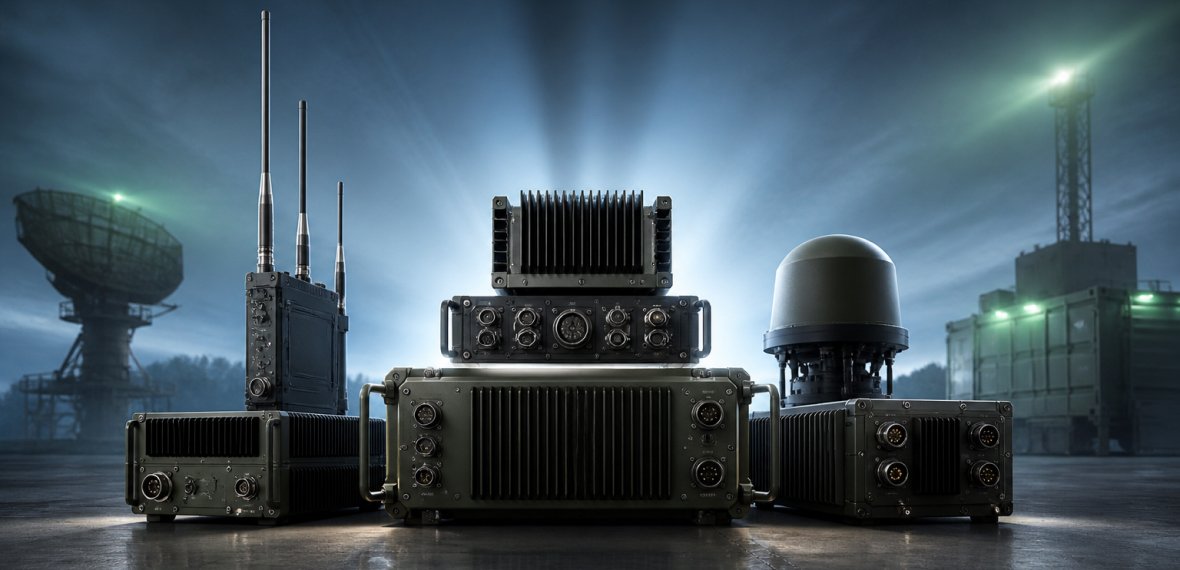
A rugged system is a computing or display unit engineered to maintain reliable operation in environments that would damage or destroy standard commercial electronics. That is the short definition. The longer one matters for procurement.
The difference between a rugged system and a commercial computer is not cosmetic. A commercial laptop rated for office use is designed for 0°C to 35°C operating temperatures, moderate humidity, and a controlled desk environment. A rugged military-grade computer built to MIL-STD-810H standards is tested across 29 environmental test methods including shock, vibration, altitude, salt fog, sand and dust, temperature extremes from minus 40°C to plus 85°C, and humidity conditions up to 95 percent non-condensing.
The engineering differences run deep. Rugged systems use sealed, fanless enclosures to prevent ingress. They use conformal-coated PCBs to resist moisture. They use solid-state storage to eliminate mechanical failure points. Connectors terminate on MIL-series fittings rather than commercial USB or HDMI ports. And they are built for operational lifespans of 10-15 years, not the 3-5 year commercial replacement cycle.
For India’s defence sector, this distinction is operationally critical. A standard computer fails on a Himalayan forward operating base in weeks. A properly specified rugged system runs for years.
Several active procurement and modernization programmes are creating direct demand for domestic rugged system suppliers right now.
The major demand drivers include:
Each of these programmes carries an explicit preference for domestic supply under DAP 2020. The opportunity for Indian rugged system manufacturers is structural, not speculative.
Being a credible rugged system supplier in India for defence applications requires meeting a specific set of certifications and capability benchmarks. This is where many distributors and importers fall short, and where genuine domestic manufacturers differentiate themselves.
MIL-STD-810H governs environmental engineering for equipment used in US and allied military applications. India’s defence procurement specifications, administered through DRDO and the Defence Procurement Organisation, mirror these standards closely. A supplier must produce test reports from accredited laboratories demonstrating that hardware passes the relevant test methods.
MIL-STD-461G governs electromagnetic compatibility (EMC) and electromagnetic interference (EMI). This is non-negotiable for defence applications because military vehicles carry radar, radio, and electronic warfare systems all generating RF energy. A rugged computer that fails EMC testing will be disrupted by its own vehicle’s electronics in the field.
IP ratings under IEC 60529 define protection against solid particulates and liquids. IP65 means fully dust-tight and protected against water jets. IP67 means complete dust protection and submersion to one meter for 30 minutes. Defence procurement specifications typically require IP65 minimum for ground-based systems.
DAP 2020 specifies minimum indigenous content percentages that range from 40 percent to 60 percent depending on the procurement category. For a rugged system supplier to qualify under “Buy Indian” categories, the hardware must be assembled and tested domestically, and a defined share of components (by value) must be sourced within India.
This pushes suppliers toward establishing genuine design and manufacturing capability, not just re-labeling imported hardware. Suppliers with domestic engineering teams who can customize form factor, I/O configuration, and thermal design to meet specific platform requirements are far better positioned than pure importers.
Defence platforms have operational lives of 20-30 years. A rugged computer procured for an armored vehicle in 2026 may need technical support and component availability through 2045. Domestic suppliers who can guarantee long-term support, spare parts availability, and technology refresh capability create a procurement advantage that no import-based solution can match.
| Criterion | Domestic Indian Supplier | Imported System |
|---|---|---|
| DAP 2020 Procurement Preference | High (Make I/II, Buy Indian eligible) | Low (Buy & Make Indian only) |
| Long-term Support & Spares | Available domestically | Dependent on foreign OEM |
| Customization for Indian Platforms | Feasible, shorter lead time | Costly, long lead time |
| Technology Transfer | Possible under MoU / JV | Often restricted |
| Indigenous Content Compliance | Achievable | Typically below DAP threshold |
| Cost Over Lifecycle | Lower (no import duty, local support) | Higher (duties, shipping, forex risk) |
| Certification Lead Time | Faster with DRDO coordination | Longer, foreign lab dependency |
This table tells a clear story. For routine procurement of commercial-off-the-shelf (COTS) electronics, imports remain competitive. But for mission-critical rugged electronics tied to long-duration defence platforms, the case for domestic supply is overwhelming on every dimension except, occasionally, on day-one technical specification.
Rugged displays are one of the most visible hardware categories in India’s defence electronics modernization, and one of the most technically demanding to produce domestically.
An avionic display installed in a military aircraft must meet standards that go well beyond what any industrial or commercial display is designed for. It must function across temperatures from minus 55°C to plus 70°C. It must remain readable in direct sunlight at high altitude (typically requiring 1,500 cd/m2 or greater luminance). It must survive the vibration profile of a gas turbine engine during both normal and high-g maneuver flight. And it must pass DO-160G, the avionics environmental qualification standard that governs all airborne electronics.
For ground-based defence applications, rugged military LCD displays in command vehicles and control centers require MIL-STD-810 compliance, wide input voltage tolerance (typically 9-36V DC to handle military vehicle power bus fluctuations), and connectors that terminate on MIL-series fittings for field-connectable harnesses.
India has historically imported a large share of its defence displays from US, Israeli, and European suppliers. The Make in India programme is creating the policy conditions for domestic suppliers to fill that gap. Suppliers who combine display manufacturing capability with systems integration experience, meaning they can integrate the display into a full console or operator station, not just supply the panel, are the ones capturing the most meaningful defence contracts.
The production capacity question is one that sceptics raise legitimately. Can India actually manufacture rugged electronics at the quality and volume defence programmes require?
The honest answer is: yes, and faster than most outside the sector realize.
In my experience working closely with defence electronics procurement teams, the gap between import quality and domestic quality for rugged computing hardware has narrowed significantly between 2020-2025. The combination of component access through improved semiconductor distribution networks, engineering talent from India’s strong electronics engineering base, and investment driven by DAP incentives has moved domestic capability to a credible position.
Dr. Ajay Kumar, former Defence Secretary of India, stated in 2023 that “the defence industrial ecosystem has matured to a point where Indian private sector players are not just assembling components but designing systems.” That shift from assembly to design is exactly what separates a genuine rugged system supplier in India from a reseller.
The semiconductor supply chain has been a persistent bottleneck. The CHIPS-equivalent investments India is making through the India Semiconductor Mission (ISM), with Rs 76,000 crore in approved incentives as of 2023-2024, will eventually reduce import dependency for the core components inside rugged systems. That timeline is measured in years, not decades.
Data acquisition systems represent another area where Indian manufacturers are gaining ground. DAQ hardware used in weapons testing, vehicle health monitoring, and simulation systems was almost entirely imported a decade ago. Today, domestic suppliers are producing ISA/PCI/PCI-104/cPCI/VME form factor DAQ cards that meet the technical requirements of DRDO test ranges.
For defence original equipment manufacturers and system integrators evaluating their supply chain, the answer is yes, with the right due diligence. Here is a practical checklist:
Analysts at Frost and Sullivan projected in 2023 that India’s defence electronics market would grow at a CAGR of 14.7 percent through 2027-2028, reaching approximately USD 10.6 billion. Suppliers who establish credible indigenous capability now are positioning for a procurement wave that is structurally set to continue regardless of policy changes.
Make in India defence electronics is not a slogan. It is a structural shift in how India acquires, produces, and sustains the technology its armed forces depend on. As of 2026, that shift is well underway, and rugged systems sit at its technical core.
The key takeaway is this: India’s defence electronics indigenization is creating a durable, growing market for domestic rugged system suppliers who can meet MIL-STD certification requirements, provide long-term support, and demonstrate genuine indigenous content.
For procurement teams in defence and paramilitary organizations, the evaluation framework has changed. You are no longer just comparing specifications and prices. You are comparing lifecycle support capability, indigenous content percentages, and the supplier’s ability to co-develop solutions for your specific platform. These dimensions heavily favor domestic suppliers who have invested in engineering capability, not just distribution.
For system integrators building platforms for DRDO or DPSU programmes, partnering early with a qualified rugged system supplier in India gives you access to customization, faster certification timelines, and the DAP compliance benefits that make your own bid more competitive.
For anyone newer to this domain, whether you’re a procurement officer, an engineer, or a programme manager trying to understand where Indian industrial capability actually stands, the picture is clearer than the headlines suggest. The capability is real. The policy backing is strong. The demand pipeline through the end of the decade is substantial.
The next step is straightforward: if you need rugged computers, MIL-grade displays, data acquisition systems, or defence-grade components for a specific application, reach out to a qualified domestic supplier who can walk you through the specifications, certifications, and timelines that apply to your programme. You can explore Arise O Tech’s full product range or get in touch directly to discuss your requirements. The conversation moves faster than most procurement officers expect, and the domestic alternatives are better than many engineers assume.
FAQ
What is Make in India defence electronics?

Make in India defence electronics is a policy-backed framework under India’s Defence Acquisition Procedure (DAP) that prioritizes electronics hardware designed, manufactured, and tested within India for defence procurement. It includes funding categories like Make I, Make II, and Buy Indian, each with minimum indigenous content thresholds. The goal is to reduce India’s reliance on defence electronics imports, which totaled over USD 4.5 billion in 2020-2021, according to SIPRI.
Who are the main rugged system suppliers in India for defence applications?
Key rugged system suppliers in India for defence applications include Bharat Electronics Limited (BEL) for large-scale systems, Hindustan Aeronautics Limited (HAL) for avionics, and a growing segment of private-sector manufacturers who design and assemble MIL-STD-certified rugged computers, displays, and data acquisition hardware domestically. Suppliers like Arise O Tech Electronics serve the Indian market with rugged computers, MIL-grade displays, and avionic systems built to defence environmental standards.
What is the difference between a rugged computer and an industrial computer for defence use?
A rugged computer is built for direct environmental exposure in extreme conditions, tested to standards like MIL-STD-810H covering shock, vibration, temperature extremes, and ingress protection. An industrial computer is designed for factory or controlled environments where temperature and dust are managed but physical shock and outdoor exposure are not primary concerns. For defence deployments in vehicles, aircraft, or field command posts, rugged computers are the required choice. Industrial computers are appropriate only for base facility or controlled-environment installations.
How does DAP 2020 support domestic defence electronics manufacturers?
The Defence Acquisition Procedure 2020 supports domestic manufacturers through procurement category preferences. “Buy Indian” requires a minimum of 50-60 percent indigenous content by value. “Make I” provides up to 70 percent government funding for domestic development projects. These categories give domestically manufactured rugged electronics a structural advantage over imports in government and defence tenders. Companies with verifiable indigenous content documentation and domestic manufacturing facilities benefit most directly from these provisions.
What certifications should a rugged system supplier in India hold for defence contracts?
A credible rugged system supplier in India should hold or be able to demonstrate compliance with MIL-STD-810H (environmental testing), MIL-STD-461G (electromagnetic compatibility), and relevant IP ratings under IEC 60529. For airborne applications, DO-160G qualification is required. Test reports should come from NABL-accredited or internationally recognized laboratories. Suppliers should also demonstrate quality management certification under ISO 9001 or AS9100 for aerospace-grade hardware.
What types of rugged systems are used in Indian Army vehicles?
Indian Army armored vehicles, including the T-90S Bhishma and BMP-II infantry fighting vehicle, use ruggedized computing systems for fire control, navigation, and battlefield communication. These systems must survive severe mechanical shock and vibration, temperature extremes, and electromagnetic interference from co-located radio and radar equipment. Specifications typically require MIL-STD-810H and MIL-STD-461G compliance, sealed enclosures with IP65 or higher rating, and connectors terminating on MIL-series fittings for field reliability.
How do rugged displays for defence differ from regular industrial monitors?
Rugged defence displays are built to MIL-STD-810H environmental standards and use MIL-series connectors, wide-range DC input power (typically 9-36V), and high-luminance panels (up to 3,500 cd/m2) for sunlight readability in the field. Regular industrial monitors are designed for controlled environments, use standard commercial connectors, and are not tested for shock, vibration, or temperature extremes at military levels. The operating temperature range for defence displays typically spans minus 40°C to plus 85°C, far beyond the range of any commercial display.
What is iDEX and how does it connect to rugged electronics in India?
iDEX (Innovations for Defence Excellence) is a Government of India initiative that funds startups and small businesses to develop innovative defence technology solutions. Since its launch in 2018, over 300 challenges have been issued, with a significant number involving embedded computing, rugged communication systems, and sensor hardware. iDEX provides a procurement pathway for companies developing new rugged electronics capabilities, offering contracts that validate technology without requiring the full DRDO qualification process. It is one of the fastest routes for new domestic suppliers to enter the defence electronics supply chain.
Why should system integrators prefer a domestic rugged system supplier in India over imports?
Domestic rugged system suppliers offer three advantages imports cannot match: DAP 2020 compliance support for indigenous content requirements, domestic long-term technical support and spare parts availability, and the ability to customize hardware for specific Indian platform requirements with shorter lead times. Import-dependent supply chains expose programmes to forex risk, customs duty costs, foreign OEM policy changes, and technology transfer restrictions. For platforms with 20-30 year operational lives, domestic support capability is a programme risk reduction measure, not just a cost consideration.
What is the outlook for Make in India defence electronics through 2026-2030?
India’s defence electronics market is projected to grow at a CAGR of approximately 14.7 percent through 2027-2028, reaching around USD 10.6 billion, according to Frost and Sullivan analysis. Government policy continues to raise the bar on indigenous content requirements and expand the “positive indigenisation list,” which restricts imports of specified items after defined dates. The combination of active procurement programmes (BMS, TCS, naval modernization, Tejas avionics), iDEX funding, and India Semiconductor Mission investments creates a sustained demand environment for domestic rugged system suppliers through at least the end of the decade.