

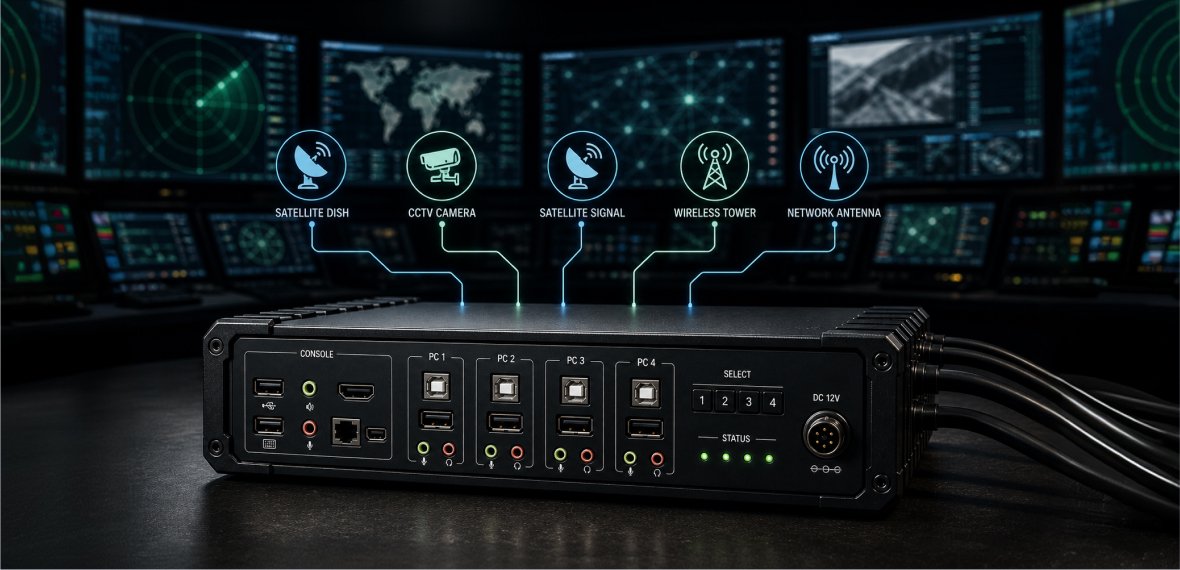

Uploaded on - 28 May 2026
When a military command centre goes down because of a single wrong equipment choice, the cost is not measured in rupees. It is measured in lives, intelligence gaps, and compromised national security. That is the weight a procurement officer carries every time a KVM product decision lands on their desk.
This guide is written specifically for defence establishments, military installations, naval command rooms, and government security operations in India. If you are evaluating KVM switches, extenders, consoles, or matrix systems for a mission-critical environment, what follows is everything you need to know before committing to a purchase.
KVM stands for Keyboard, Video, and Mouse. A KVM switch allows one operator to control multiple computers from a single set of peripherals. In a civilian IT environment, this is a convenience. In a military command centre, it is an operational necessity.
Defence command rooms routinely run anywhere from eight to over a hundred networked systems simultaneously, covering radar feeds, satellite data, communication links, surveillance inputs, battlefield management software, and logistics platforms. Routing separate keyboards, monitors, and mice to each of these systems is not just impractical, it is a physical and security impossibility in a confined, hardened command space.
A properly specified KVM system allows a small team of operators to access all of these systems from organized, secure consoles, switch between classified and unclassified networks without cross-contamination, and maintain full situational awareness at all times.
For Indian defence establishments working under DRDO guidelines, Ministry of Defence procurement standards, and increasingly under Make in India mandates, the selection of a KVM product is not a routine IT purchase. It is a systems-level decision.
If you want to understand the broader range of rugged systems that support Indian defence infrastructure, explore our full defence electronics products.
Before going into specific selection criteria, it is important to understand why you cannot simply deploy a commercial-grade KVM switch in a defence command environment.
Commercial KVM switches are built for office-grade conditions. They are housed in standard plastic or light sheet-metal enclosures, designed for stable 20 degree Celsius rooms, and rated for maybe five years of continuous use in benign environments.
Military environments are different in every possible way. A shipborne command room faces constant vibration, humidity, salt fog, and power fluctuations. A mobile ground command post operates in dust, heat ranging from minus 20 to plus 55 degrees Celsius, and may be subject to mechanical shock during transport. A fixed underground bunker runs 24 hours a day, 365 days a year, demanding equipment with an MTBF of 50,000 hours or more.
Military-grade KVM products, like those available through Arise O Tech’s KVM product range, are built in MIL-STD aluminum alloy enclosures, designed for rack-mounted deployment at 1U or 2U form factors, and engineered to survive the environmental conditions that standard enterprise equipment simply cannot handle.
This is the most significant difference. In a military command centre, a KVM switch is not just a switching device. It is a security boundary. When an operator switches between a classified network terminal and an unclassified workstation, the KVM system must ensure there is zero possibility of data passing between the two channels.
Commercial KVM switches offer no such guarantee. Many use shared memory buffers that can technically allow data to persist between connected sources. This is completely unacceptable in any environment handling sensitive defence information.
Military-grade KVM switches use hardware-enforced isolation, meaning each port is electrically isolated from every other port. No data, no keystroke logging, no video buffer contents can bleed from one connected system to another. Some TEMPEST-rated KVM systems go further, with shielded enclosures and filtered power inputs to prevent electromagnetic emanation from leaking classified information.
Defence computing environments in India use a wide variety of display interfaces across generations of hardware. A modern KVM product deployed in an existing command room may need to simultaneously handle DVI, VGA, HDMI, HDSDI, and in some older installations, composite video inputs. Military-grade KVM systems support this heterogeneous interface environment through built-in converters, extenders, and splitters.
Arise O Tech’s rugged display solutions are a reference point for understanding the display interface standards used in Indian defence environments, since the KVM and display systems need to be specified together for a coherent command room deployment.
The first question any procurement team asks is: how many systems does this KVM need to control?
For small tactical operations centres or forward command posts, an 8-port KVM may be sufficient. For a naval operations room or an air defence command centre, you may need a matrix system supporting 128 ports or more.
The critical issue is not just the current port count. It is whether the system can scale. Military infrastructure evolves. New systems get added. Hardware gets upgraded. A KVM product that requires a full replacement rather than a simple expansion when you add 16 more sources is a procurement liability.
Look for:
Command room displays are not general-purpose monitors. Indian defence installations increasingly deploy rugged military-grade displays that support resolutions up to 1600×1200 and beyond. Your KVM switch must support the maximum resolution of every display in the command room, without downscaling.
Downscaling is a serious operational risk. An operator reading a satellite map or a radar overlay at reduced resolution will miss details that matter. Mission-critical display environments require the KVM system to support native resolution across all connected displays.
Key display specifications to verify:
This is non-negotiable for any KVM product deployed in Indian military infrastructure. MIL-STD (Military Standard) compliance covers a range of environmental and electronic tests that commercial equipment is never subjected to.
The most relevant MIL-STD specifications for KVM products in Indian defence environments include:
MIL-STD-461 covers electromagnetic interference (EMI) and electromagnetic compatibility (EMC). A KVM system installed in a command room that generates or is susceptible to EMI can disrupt radar systems, communication equipment, and other sensitive electronics installed nearby.
MIL-STD-810 covers environmental testing across 29 test methods including temperature, humidity, altitude, vibration, shock, and sand and dust exposure. For a KVM system deployed in a naval vessel, forward command post, or mobile operations vehicle, MIL-STD-810 compliance is the baseline requirement.
TEMPEST (SDIP-27/NACSIM 5100B) is the NATO standard for electromagnetic shielding of equipment handling classified information. While India follows its own classified information protection standards, TEMPEST-rated KVM equipment provides the highest assurance that signals from classified systems cannot be intercepted through electromagnetic emanation.
When evaluating a KVM product, ask for the specific MIL-STD test reports, not just a statement of compliance. Indian defence procurement has historically suffered from vendors self-declaring compliance without third-party verification.
In a military command room, the keyboard and touchpad integrated into a KVM console are used by multiple operators in gloves, in high-stress conditions, and often in low-light environments. The physical ergonomics and durability of the input interface matter as much as the electronics behind it.
Look for:
Industrial workstations from Arise O Tech use built-in membrane keyboards as a reference for ruggedized input design, and similar principles apply to KVM console keyboards in defence environments.
Military installations in India face power supply challenges that civilian data centres never encounter. Forward operating bases may rely on generator power with significant voltage fluctuations. Naval vessels have DC power distribution systems. Mobile command posts switch between shore power and vehicle power.
Your KVM system must support:
In a full-scale military operations room, the rack-mounted servers and computing infrastructure are often physically separated from the operator consoles by tens or even hundreds of metres. Running individual cables for keyboard, video, and mouse from each server to each operator position is not feasible.
KVM extenders solve this by transmitting the keyboard, video, and mouse signals over long distances using CAT5E, CAT6, or fiber optic cabling. This allows the computing hardware to remain in a secure, climate-controlled server room while operators work at consoles in the main command area.
Specifications to verify for extenders:
Beyond extenders, the full KVM product ecosystem includes VGA, DVI, HDMI, and USB splitters that allow a single source to be broadcast to multiple displays simultaneously. This is used in command rooms where the same intelligence feed, map overlay, or briefing display needs to be visible at multiple operator stations.
This is the most complex and most critical specification for any KVM product used in Indian defence environments, and it is the area where most procurement teams have the least technical depth.
A military command room routinely connects to networks of different classification levels. A single operator may need to access a top-secret command system, a classified communications network, and an unclassified internet terminal, all from the same physical desk.
A standard KVM switch allows switching between these systems. A secure KVM switch goes further by providing hardware-enforced data path isolation, meaning there is no shared memory, no shared bus, and no electronic pathway through which data from a classified channel can reach an unclassified one.
Critical security features to require in a military KVM system:
Military KVM consoles are rack-mounted systems. The operator-facing display is integrated into the same 1U or 2U rack unit as the keyboard and the switching electronics. The available display sizes and their suitability for different environments include:
The MTBF of the integrated LCD display is particularly important. Look for 50,000 hours minimum. At 24/7 operation, this represents roughly 5.7 years of continuous use before a statistically expected failure, which aligns with typical Indian defence equipment lifecycle requirements.
For larger display needs in command room environments, Arise O Tech’s industrial monitors offer sizes from 1.8 inches to 100 inches with MIL-STD compliance.
The most common deployment. A self-contained 1U or 2U unit that integrates the display, keyboard, touchpad, and KVM switch electronics into a single rackmount chassis. These slide out from the rack for use and retract for transport or space efficiency.
Used in: Naval operations rooms, air defence command centres, Army operations rooms, ISR (Intelligence, Surveillance, Reconnaissance) centres.
For large-scale command environments where multiple operators need simultaneous, non-conflicting access to a large pool of computing resources, a KVM matrix system is deployed. Unlike a simple switch (one operator, multiple sources), a matrix allows N operators to simultaneously access M sources, with each operator having independent control of a different source.
Used in: National-level operations centres, multi-service joint command facilities, large naval installations.
Separate the operator console from the computing hardware over distances of 100 to several thousand metres. Fiber-based KVM extenders are preferred in Indian naval environments where copper cabling poses electromagnetic interference risks near sensitive sensors.
Used in: Aircraft carriers, large naval vessels, hardened underground command facilities, large air bases.
Allow a single source to drive multiple displays simultaneously. Used in command rooms where a common tactical display or briefing screen must be visible to all operators.
Used in: Briefing rooms, joint operations centres, air traffic control facilities.
India’s defence electronics procurement operates through several channels that directly affect how KVM products are sourced and qualified.
DRDO (Defence Research and Development Organisation) sets technical standards for electronic systems used in Indian military platforms. Any KVM product deployed on a DRDO-developed platform must meet DRDO-specified environmental and EMC standards.
MIL-STD equivalence is the common benchmark. Indian defence procurement generally accepts MIL-STD-810 and MIL-STD-461 certified products as meeting or exceeding the environmental and electromagnetic requirements of Indian defence specifications.
Make in India and IDDM (Indian Indigenously Designed, Developed and Manufactured) policies have changed the procurement environment significantly. Defence establishments are now actively encouraged to source from Indian manufacturers and distributors who can support local maintenance, spare parts availability, and lifecycle management.
Arise O Tech Electronics is positioned within this ecosystem as an Indian distributor and solutions provider for rugged electronics, including KVM products built to MIL-STD specifications, supported by local engineering and after-sales capability.
GeM (Government e-Marketplace) registration is increasingly important for vendors supplying KVM and other electronics to Indian defence establishments. When evaluating suppliers, confirm their GeM registration and prior defence supply track record.
Procurement teams often specify exactly the number of ports currently required. Within two to three years, as systems are added to the command room, the KVM is already at capacity. Always procure with a 30 to 50 percent headroom for expansion.
A KVM switch without a properly planned cabling infrastructure is half a solution. The choice of CAT5E versus CAT6 versus fiber affects your maximum extension distances, EMI susceptibility, and bandwidth ceilings. The KVM product and the cabling plan must be specified together.
MIL-STD compliance must be backed by actual test reports from accredited testing laboratories. Self-certification or marketing materials stating compliance without test report reference numbers should be treated as non-compliant.
The integrated display in a KVM console is often the first component to fail in continuous-use environments. Specifying a display with a 30,000-hour MTBF instead of 50,000 hours will result in a console replacement well within the operational lifecycle of the command room.
The single most dangerous procurement error is deploying a standard KVM switch in an environment that handles classified information. If your command room connects to networks of different classification levels, a secure KVM switch with hardware-enforced isolation is mandatory, not optional.
If you are a systems integrator or procurement officer drafting a specification for a military KVM system, the following parameters should appear in your RFP:
Form Factor: 1U or 2U rack-mount, 19-inch rack compatible
Display Size: State the required diagonal size (15″, 17″, 19″, or 21″) and minimum resolution
LCD MTBF: Minimum 50,000 hours
Port Count: State the required port count with expansion path
KVM Switch Architecture: State whether point-to-point, matrix, or extended matrix is required; specify CAT5E/6 or fiber interface for extenders
Input Interface: List all video interfaces required (VGA, DVI, HDMI, HDSDI, NTSC, PAL, S-Video)
Keyboard: 105-key with PS/2 and USB interface, touchpad or trackball option
Power Supply: Specify AC and/or DC input range, redundant power supply requirement
Environmental Compliance: MIL-STD-810G (environmental), MIL-STD-461F (EMC), with test report references required
Security: Hardware-enforced port isolation (if classified networks are involved), TEMPEST rating if required
Operating Temperature: State the required range (typically -20 degrees Celsius to +55 degrees Celsius for ground-based and up to -40 degrees Celsius to +85 degrees Celsius for shipborne)
Signal Converters: List required converter types (VGA to DVI, DVI to HDMI, etc.)
Splitters and Extenders: State requirements including types and distances
A KVM product installed in a defence command room is not replaced at the first sign of trouble. It is repaired, maintained, and kept operational. In a command room running 24/7, a failed KVM console that sits unrepaired for three weeks waiting for a spare part from an overseas OEM represents a real operational gap.
This is one of the strongest arguments for sourcing KVM products through Indian defence electronics specialists who maintain local spares, can provide on-site support, and understand the administrative procedures required to service equipment in a classified environment.
The Arise O Tech approach to rugged systems procurement covers not just the initial supply but the full lifecycle, from requirements analysis through to long-term support. Our rugged computer systems and data acquisition systems are deployed alongside KVM solutions to create integrated, fully supportable command room environments.
For procurement discussions or technical specification support, reach out to our team through the Arise O Tech contact page.
A KVM system does not operate in isolation. In a fully integrated defence command room, it connects with and depends on several other systems.
Rugged computing platforms are the sources that the KVM system switches between. Arise O Tech’s rugged computers are built to MIL-STD specifications, making them natural integration partners for military-grade KVM deployments.
Rugged displays serve as the primary operator interface alongside KVM consoles. For large-format displays in the main command room, rugged display systems with sun-readable capability and MIL-STD compliance are the appropriate choice.
Industrial workstations provide the processing backbone for specific command room functions. Arise O Tech industrial workstations support expansion configurations compatible with command room architectures.
Simulator systems are increasingly integrated into command rooms for training and mission rehearsal. Simulator products that share the same KVM infrastructure as operational systems allow seamless transition between live operations and simulation modes.
The goal is a command room where all of these systems are sourced, specified, and supported through a single Indian defence electronics partner who understands the full system architecture, not just the individual components.
FAQ
What is a KVM switch and why is it used in military command centres in India?

A KVM switch allows one or more operators to control multiple computers from a single set of keyboard, video display, and mouse peripherals. In Indian military command centres, this is essential because operators manage dozens to hundreds of networked systems simultaneously, covering radar, communications, satellite feeds, and battlefield management tools. A KVM switch consolidates control, reduces equipment clutter, and when properly specified, enforces security boundaries between networks of different classification levels.
What is the difference between a standard KVM switch and a secure KVM switch for defence use?
A standard KVM switch shares memory buffers between connected computers, which creates a risk of data leaking between them. A secure KVM switch uses hardware-enforced electrical isolation, meaning each connected computer has a completely separate data path with no possibility of data crossing between channels. In defence environments where a single console may connect to both classified and unclassified networks, a secure KVM is a security requirement, not an option.
What MIL-STD certifications should a KVM switch have for Indian defence applications?
The most relevant standards are MIL-STD-810G or MIL-STD-810H for environmental testing (covering temperature, humidity, vibration, shock, dust, and altitude) and MIL-STD-461F or MIL-STD-461G for electromagnetic compatibility. Additionally, TEMPEST certification (following SDIP-27 or NACSIM 5100B) is required for systems handling classified information where electromagnetic emanation could expose data. Always ask the vendor for actual test reports with accredited laboratory reference numbers, not just compliance declarations.
How many ports does a KVM switch typically need for an Indian military command centre?
This varies significantly by application. A small tactical operations centre might need 8 to 16 ports. A medium-scale command room typically requires 32 to 64 ports. Large joint command centres, naval operations rooms, and air defence command facilities may require matrix systems supporting 128 ports or more. Procurement teams should specify current requirements plus at least 30 to 50 percent future expansion headroom to avoid system replacement within the operational lifecycle.
What is a KVM extender and when is it needed in a defence installation?
A KVM extender separates the operator console from the computing hardware using a cable infrastructure, typically CAT5E/6 or fiber optic. This is needed when the computing hardware must be in a physically separate, secured room from the operator consoles, which is standard practice in most fixed command rooms. CAT5E/6 extenders support distances of 150 to 300 metres. Fiber optic KVM extenders can reach several kilometres, making them suitable for large naval installations or distributed command architectures.
Can a KVM switch handle multiple video interfaces like VGA, DVI, and HDMI simultaneously?
Yes, military-grade KVM systems include built-in signal converters, splitters, and extenders that support heterogeneous video environments. A single command room may have legacy systems with VGA outputs, newer systems with DVI or HDMI, and specialized systems with HDSDI. A properly specified military KVM system handles all of these through the appropriate converter modules without requiring replacement of the connected computing hardware.
What is the expected operational lifespan of a military KVM console and what is MTBF?
MTBF (Mean Time Between Failures) is the standard metric. For military KVM consoles, the integrated LCD display should have an MTBF of at least 50,000 hours. At continuous 24/7 operation, this is approximately 5.7 years before a statistically expected failure. The overall system MTBF should be specified separately for the electronics. Indian defence procurement typically targets a 10-year operational lifecycle, meaning MTBF specifications should be matched to the procurement and lifecycle plan.
Is it mandatory to use a Make in India KVM switch for Indian defence procurement?
Under current Indian defence procurement policies, IDDM (Indian Indigenously Designed, Developed and Manufactured) category products receive preferential treatment and in many categories, sourcing from Indian entities is mandated. While specific KVM product indigenization requirements vary by programme, sourcing through Indian defence electronics distributors with local support capability, GeM registration, and established defence supply credentials is strongly preferred under current procurement guidelines.
What is TEMPEST-rated KVM equipment and does India require it?
TEMPEST is a NATO standard governing the electromagnetic shielding of equipment that handles classified information. TEMPEST-rated KVM equipment is designed so that the electromagnetic signals it emits do not carry intelligible information that could be intercepted by a nearby adversary. India’s own classified information protection standards align directionally with TEMPEST principles. For Indian defence applications involving highly classified networks, procurement teams should specify the applicable emanation security standard with their technical authority.
How do I evaluate a KVM supplier for Indian military procurement?
Key evaluation criteria include: demonstrated defence supply track record with reference installations, MIL-STD compliance verified by third-party test reports, local Indian presence for support and spare parts, GeM registration, ability to provide custom configurations for specific Indian defence requirements, engineering support for system integration (not just box supply), and commitment to local repair and maintenance capability rather than overseas RMA processes.