

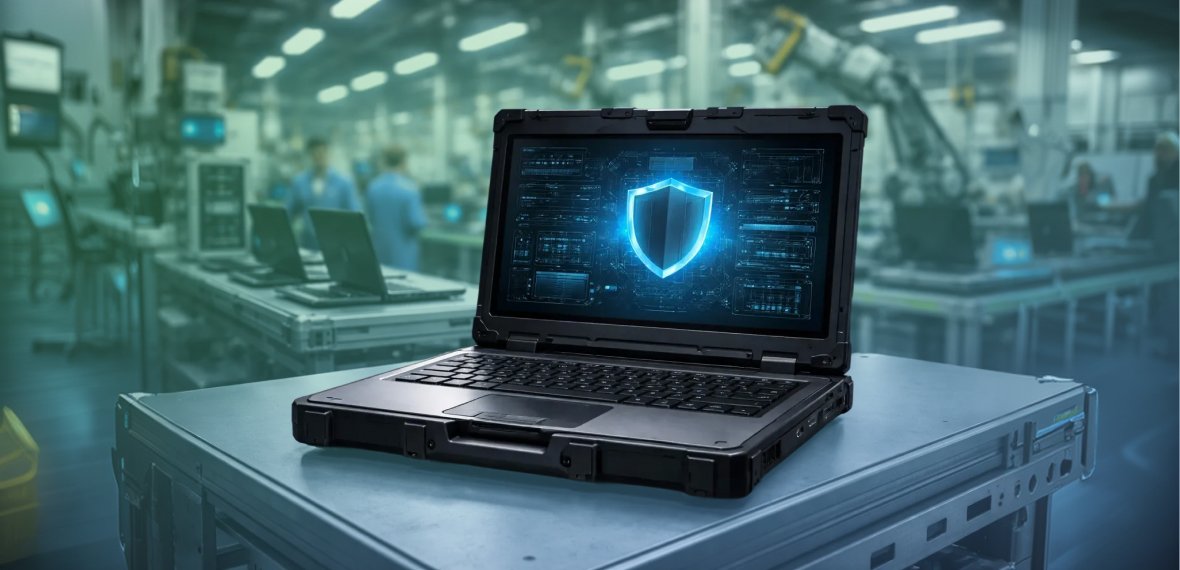

Uploaded on - 21 January 2026
Most laptops are designed for desks, air-conditioned offices, and predictable routines. But a growing number of professionals don’t work in predictable environments. They work in dust, rain, vibration, heat, cold, and constant movement- places where a standard laptop becomes a liability rather than a tool.
This article answers a practical question many decision-makers quietly struggle with: Who actually needs a rugged laptop, and why do regular laptops fail so often in certain industries? If you’re evaluating rugged laptop manufacturers or trying to decide whether a rugged laptop supplier makes sense for your operation, this guide will help you make that call with clarity.
When a consumer or business laptop fails, the visible cost is repair or replacement. The invisible cost is downtime, lost data, delayed decisions, and operational risk.
In harsh environments, failure is not an exception – it is predictable. Hinges loosen under vibration. Keyboards fail from dust ingress. Batteries degrade faster in heat or cold. Screens become unreadable outdoors. Over time, teams compensate with workarounds, backups, and redundant devices, quietly absorbing inefficiency.
Rugged laptops exist not to look tough, but to remove these failure points entirely.
Before diving into industries, it’s important to clarify what actually differentiates rugged devices from reinforced consumer laptops.
A true rugged laptop is engineered around three principles:
Certifications like MIL-STD-810 and IP ratings matter, but real-world design choices matter more: sealed ports, reinforced chassis, industrial batteries, and long product lifecycles.
Construction sites expose devices to dust, debris, vibration, and weather changes within a single day. Regular laptops fail at hinges, fans, and ports long before the project ends.
Rugged laptops allow site engineers and supervisors to access drawings, BIM models, and reports directly on-site without protective hacks or constant fear of damage.
Factories combine heat, oil mist, vibration, and electromagnetic interference. Consumer laptops struggle with thermal stress and fine particulate ingress.
Rugged systems are designed to operate reliably on shop floors, near machinery, and in environments where maintenance access is limited.
Energy sites operate in remote, hazardous, and weather-exposed locations. Device failure here isn’t just inconvenient-it can be a safety risk.
Rugged laptops support inspection, diagnostics, and compliance documentation in environments where replacing a device may take days, not hours.
Police vehicles, field operations, and defense environments subject laptops to vibration, drops, and unpredictable handling.
Rugged laptops are chosen not for aesthetics, but for mission continuity, working reliably in vehicles, outdoor operations, and high-stress scenarios.
From loading docks to moving vehicles, logistics teams operate in motion. Regular laptops are not designed for constant opening, closing, and transport.
Rugged laptops integrate vehicle mounts, long-life batteries, and durable keyboards that support real-time tracking and dispatch without interruption.
Mining environments combine dust, moisture, vibration, and isolation. Equipment failure here often means complete operational stoppage.
Rugged devices reduce dependency on fragile peripherals and enable consistent reporting, diagnostics, and planning in extreme conditions.
Technicians servicing power lines, telecom infrastructure, or water systems work outdoors in all weather.
Rugged laptops enable access to schematics, diagnostics, and reporting tools without forcing teams to return to offices for basic tasks.
Modern agriculture relies on data – soil metrics, machinery diagnostics, and GPS-based planning-often accessed outdoors.
Regular laptops struggle with sunlight readability, dust, and moisture. Rugged laptops are built to function reliably across seasons and terrains.
Rail and transport operations expose devices to constant vibration and electrical noise. Rugged laptops are used for monitoring systems, diagnostics, and operational control where failure can cascade across schedules and safety systems.
In disaster zones, infrastructure is unstable. Devices must function without ideal conditions. Rugged laptops support coordination, data access, and communication when environments are unpredictable and time-critical.
Instead of asking “Is a rugged laptop expensive?”, ask these four questions:
If you answer “yes” to two or more, rugged laptops are not overkill -they are appropriate infrastructure.
One overlooked factor is lifecycle stability. Many rugged laptop manufacturers design platforms with long availability windows, ensuring spare parts, accessories, and compatibility for years.
Another is customization depth. The right rugged laptop supplier can tailor I/O ports, mounting solutions, storage, and thermal profiles to specific operational needs rather than forcing teams to adapt workflows.
Companies like Arise-O-Tech operate in this space by focusing on application-specific rugged systems rather than one-size-fits-all devices.
Rugged laptops are heavier, thicker, and more expensive upfront. They are not designed for casual portability or aesthetic minimalism. However, in environments where regular laptops fail repeatedly, rugged systems often cost less over time when downtime, repairs, and replacements are accounted for.
The key is matching the tool to the environment – not assuming tougher is always better.
Rugged laptops are not about durability for its own sake. They exist to remove friction, reduce failure, and support work where conditions are unpredictable by nature. If your teams operate outside controlled environments, the question isn’t whether rugged laptops are necessary – it’s how long you can afford to rely on tools that weren’t designed for the reality of your work.
FAQ
Are rugged laptops only for military or extreme use?

No. While they originated in defense applications, rugged laptops are now widely used in civilian industries like construction, logistics, utilities, and manufacturing where environmental stress is routine.
How long do rugged laptops typically last?
Rugged laptops are often designed for 5–7 year operational lifecycles, significantly longer than consumer devices, especially in harsh environments.
Can rugged laptops run standard software?
Yes. Most rugged laptops run standard operating systems and enterprise software. The difference lies in hardware resilience, not software compatibility.
Are semi-rugged laptops a good compromise?
Semi-rugged devices can work for moderately harsh environments, but they still fail under constant vibration, dust, or moisture. Environment severity should guide the choice.
Do rugged laptops require special maintenance?
Generally less than regular laptops in harsh environments. Their sealed designs reduce dust ingress and component wear, lowering maintenance frequency.
How do I choose the right rugged laptop supplier?
Look for experience in your industry, customization capability, long-term support, and clarity around certifications and warranties rather than just specifications.